Defence & Unmanned Systems
Trusted in the air Worthless if captured
- Committed to autonomous systems and drones for the UK Armed Forces
- £4bn+
- (UK Strategic Defence Review)
- Drones the UK will supply to Ukraine by the end of 2026
- 150,000
- (UK Government)
- Drones lost each month, mostly to electronic warfare
- ~10,000
- (RUSI)
- Usable keys aboard a captured Cavero-secured drone
- 0
- (Cavero Secure)
The Problem
A drone is only as secure as what it carries Every airframe is exposed long before it flies, and long after it lands
Drones are built across supply chains no single operator controls, shipped and stored for weeks, then flown into airspace saturated with jamming. Thousands are lost every month, and recovered hardware is routinely taken apart, component by component. A drone that carries a static key hands it to whoever picks it up. Once that key is extracted, an adversary can impersonate the airframe, read what it held, or talk their way into the rest of the swarm. Certificate-based identity was never built for this, and the post-quantum certificates replacing today's are too heavy for the flight controllers that need them most.
The Solution
Identity from the factory to the field Every airframe proves what it is, at every stage, for its whole working life
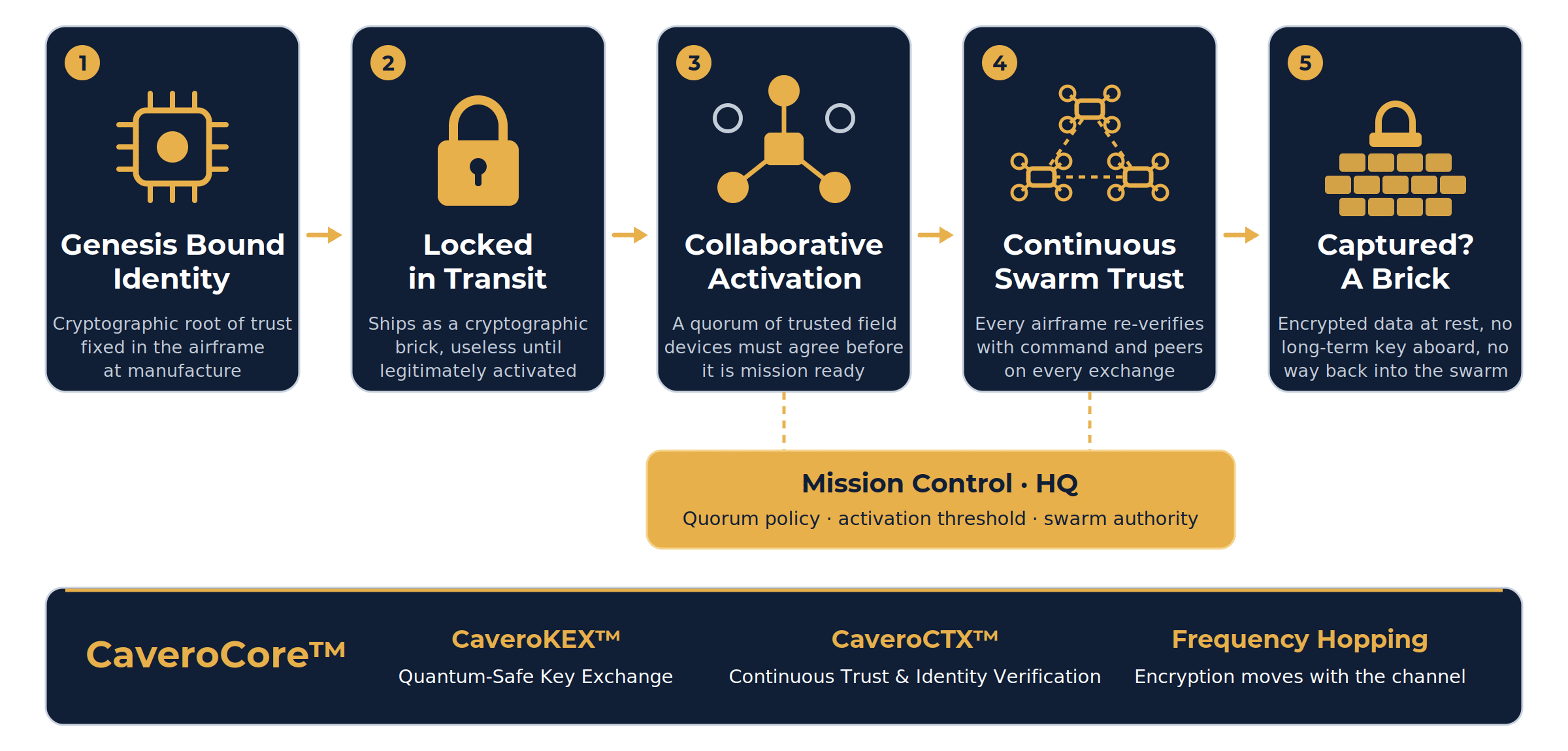
Each drone is given a Genesis Bound Identity at manufacture and ships locked. In the field, Collaborative Device Activation (CDA) requires a quorum of already-trusted devices to vouch for it before it is mission ready. In flight, CaveroCTX™ re-verifies every airframe with mission control and with every other drone in the swarm, on every exchange, so an impostor has nothing to join. And if one is brought down, its data is encrypted and no long-term key is held aboard. A captured drone is a brick; useless to an adversary and revealing nothing.
The Fit
How does this work?
Mission control defines the policy centrally: the quorum pool, how many devices must agree before an airframe is activated, and the authority each drone holds within the swarm. On the drone itself, CaveroCore™ delivers two capabilities: CaveroKEX™, a post-quantum key exchange small enough for a flight controller, running in as little as 2.1KB of RAM. CaveroCTX™, providing continuous and mutual trust between every drone and mission control. CaveroCore™ works alongside the frequency hopping already built into the drone's radio, so the encryption moves with the channel. It is crypto-agile, able to use ML-KEM or ECDH in place of CaveroKEX™ where required, and light enough to deploy to existing fleets over the air.