
CAVERO SECURE
Critical Edge Devices

Critical Edge Devices

39 billion devices Security small enough for all of them

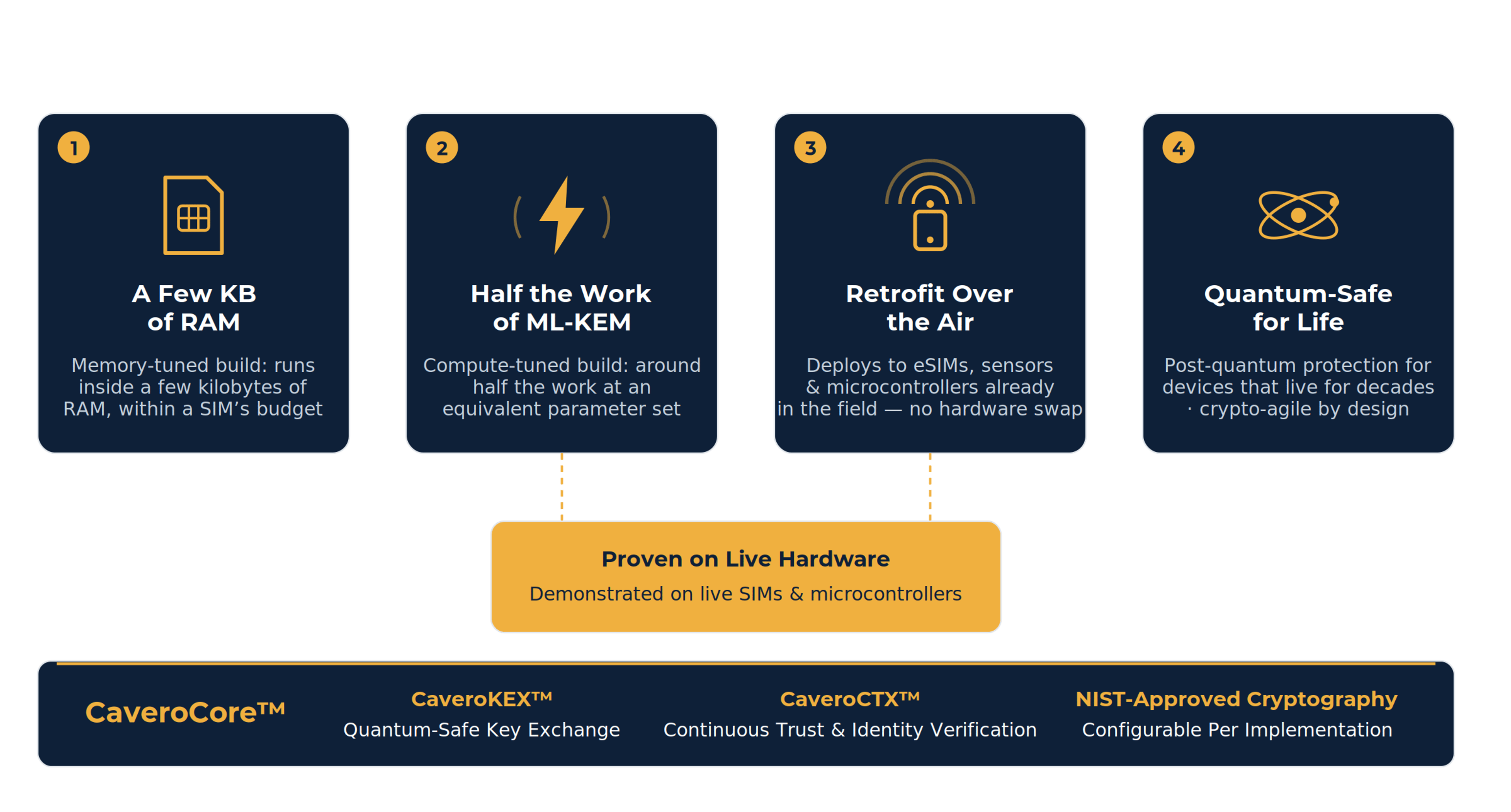
Quantum-safe key exchange in as little as 2.1KB, with half the computational requirement of ML-KEM, proven on live SIMs and delivered to in-field devices via OTA updates.

Connected devices by 2030
39B
(IoT Analytics)
The computational work of ML-KEM
50%
Measured in clock cycles
Typical device service life: longer than today's cryptography will survive
10-20 yrs
LTS IoT & OT
Demonstrated on live hardware, delivered over the air
SIMs/MCs
Constrained environments

The Problem

39 billion connected devices by 2030 Critical devices are least defensible

Smart meters, industrial sensors, medical implants, vehicle controllers, the SIMs in every connected machine: each has a few kilobytes of spare memory, an operational life counted in decades, and is protected by public-key algorithms that a quantum computer will break. NIST-standardised PQC algorithms were designed for servers and smartphones, not for hardware this small. For billions of devices, "upgrade to post-quantum" has meant "replace the hardware", which, in practice, means that vulnerabilities persist until the next hardware refresh cycle - if there ever is one.

The Solution

CaveroCore™: Edge Device PQC

CaveroCore™ was engineered to protect the edge against quantum attacks. It delivers two capabilities: CaveroKEX™, a unique PQC key exchange algorithm for constrained devices CaveroCTX™, providing continuous and mutual trust between endpoints Where memory is the binding constraint, CaveroKEX™ can be tuned to run in as little as 2.1KB of working RAM - well within the budget of a SIM card or a LoRaWAN device. Where compute and battery are the binding constraint, CaveroKEX™ can be optimised to do about half the work of ML-KEM with an equivalent parameter set, which on the edge translates directly into battery life and headroom for the device's actual job. Either way, CaveroCore™ has no certificates to store and no static credentials to steal.

CaveroCTX™ Image
module

CaveroCTX™

Continuous trust and identity verification for the life of every device, agent and connection. CaveroCTX™ is Cavero Secure's patented continuous verification protocol. Where conventional security checks identity once and assumes it ever after, CaveroCTX™ re-proves it with every exchange, building an unbroken, verifiable history from the moment of genesis onward. A clone or hijacked device cannot keep pace — the fork is exposed as soon as its history diverges, and trust is withdrawn before harm is done. And because the credential is re-derived with every exchange, it never sits still long enough to steal

CaveroKEX™ Image
module

CaveroKEX™

CaveroKEX™ is Cavero Secure's patented post-quantum key exchange. Tuned for optimal computation, it performs with around half of the computational requirements as ML-KEM at an equivalent parameter set; tuned for minimum footprint it runs in as little as 2.1KB of RAM*. Neither party ever transmits the key: both derive it, so there is no secret in flight to intercept and no static credential left on the device to steal

Critical Edge Devices

The Technology

Learn how CaveroCore™ works

Because CaveroCore™ is so compact, it can be deployed over the air to eSIMs, sensors and microcontrollers in the field today, turning devices you can't practically replace into devices you don't have to. CaveroCore™ is fully owned by Cavero Secure, a wholly British company with no third-party dependencies. It's crypto-agile, so you can configure the key exchange to meet each endpoint's requirements, and it's available in a build using only NIST-approved algorithms for deployments that must meet FIPS 140-3 requirements.

CaveroCore™

CaveroCore™

CaveroCore™ brings together three elements in a single optimised solution: CaveroKEX™, our quantum-safe key exchange; CaveroCTX™, our continuous trust and identity verification protocol; and our own implementations of the NIST-approved cryptographic functionality that modern security depends on, including ML-KEM, AES and random number generation

Discover more

Securing the roadside: quantum-safe trust for traffic management systems
Sensors in the wild: protecting river monitoring at the edge