

Agentic AI Identity
Autonomy you can trust Authority you control
Give every agent a genesis-bound identity from the moment it's created, and continuously re-verify it using your trusted network
- Enterprise applications integrated with task-specific AI agents by end of 2026
- 40%
- Gartner
- Machine identities per human, of which 79 are AI agents
- 109:1
- Palo Alto Networks 2026 Identity Security Landscape
- Expected growth in AI agent identities over 12 months
- +85%
- Axis Intelligence
- Day-to-day work decisions made autonomously by 2028
- 15%
- Gartner
The Problem
AI agents are transacting for us browsing, booking, buying
But the world's identity infrastructure was built for humans and machines, not for delegated software that acts on its own initiative
In current models, it's almost impossible to look at an agent in your network and know who created it, what it is allowed to do, or whether it's been cloned, faked, or hijacked. If a malicious agent penetrates your defences, their attack unfolds at machine speed. The only defence is to identify every agent in your organisation and establish whether its actions are permitted before it takes them.
The Solution
Enter Cavero Secure
We ensure every agent in your organisation receives a genesis-bound identity, cryptographically bound to the human or system that created it, the moment it is created. That identity is then registered with the Cavero Identity Arbiter and with the devices and agents in your network that you already trust.
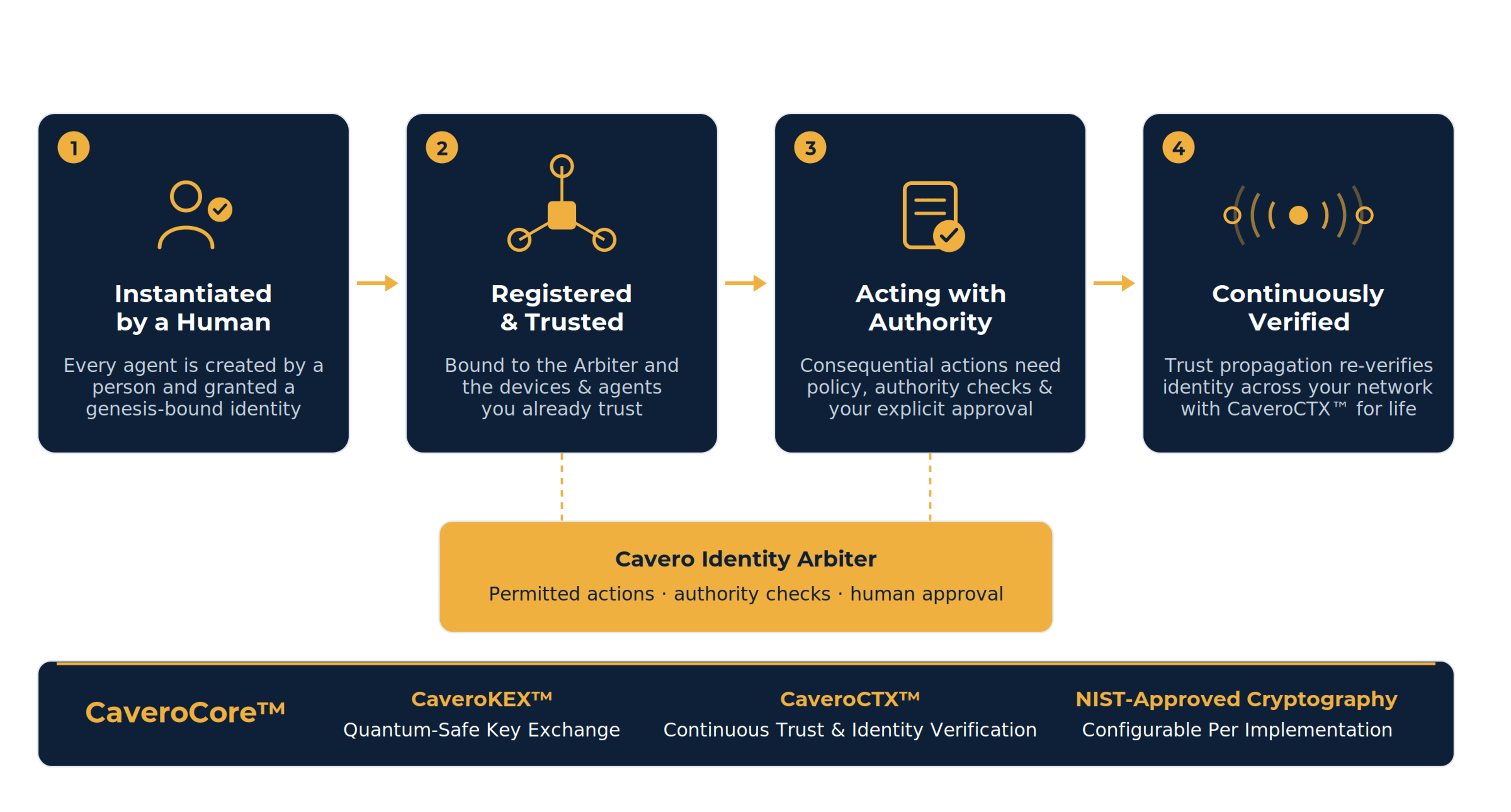
In this framework, agents operate inside a permitted-action policy you define, and when an agent attempts something consequential - a purchase, a commitment - the Arbiter checks the action against your policy, seeks verification from trusted third-party authorities, and requests your approval before anything proceeds.
The process lets the party on the other side of the request verify, in real time, that the agent is genuine, authorised, and acting for a real, accountable person.
On top of this, Cavero Secure uses a unique trust propagation model to continuously re-verify the agent's identity across your trusted device network. A cloned, diverted, or tampered agent is exposed the moment it tries to do anything, letting you block unwanted activity before it causes harm.
The fit
Where Cavero Secure sits in the agentic stack
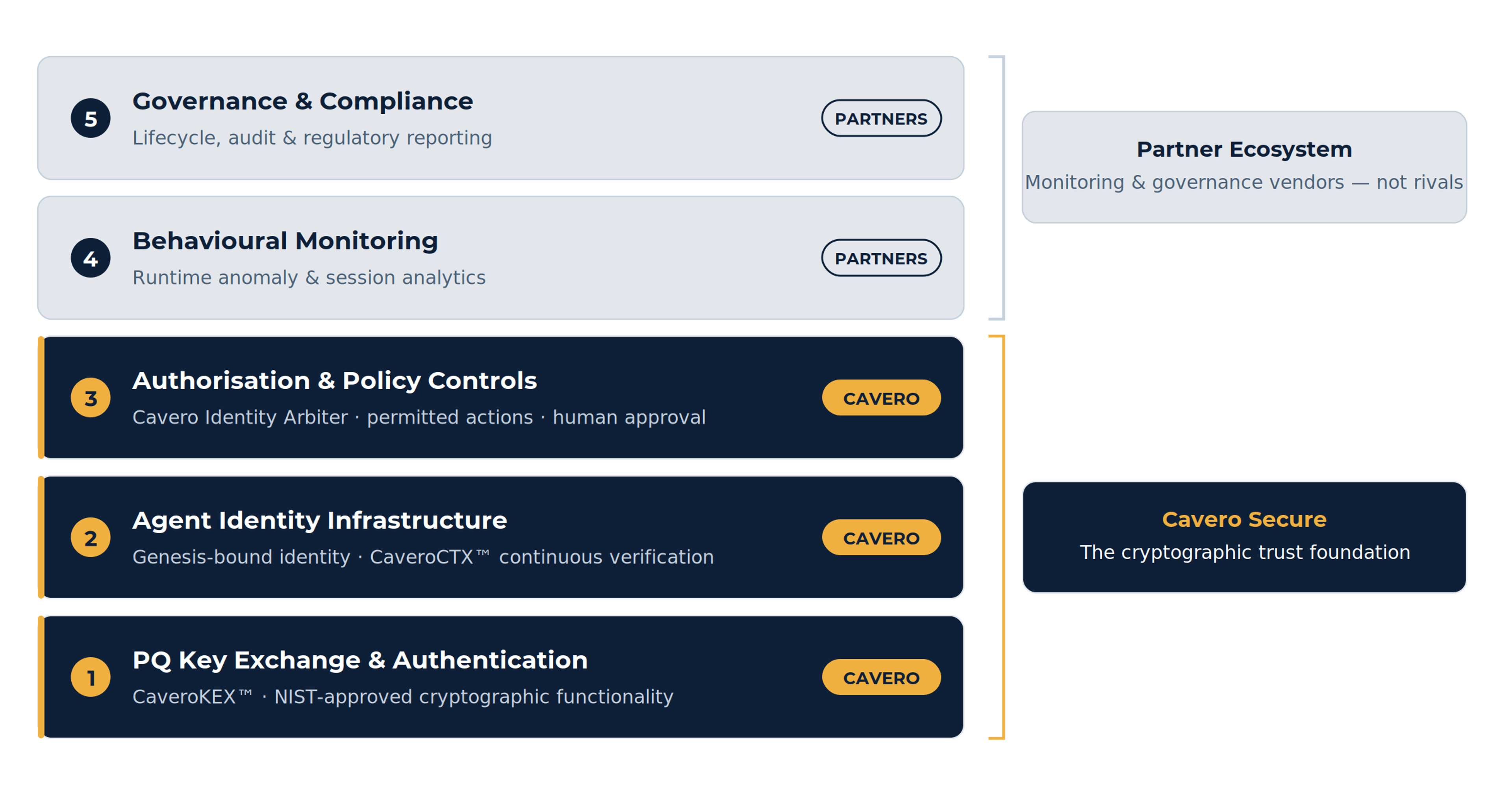
Most reference models of the agentic AI stack draw five layers, with identity in the top layer: the control plane. In practice, identity runs through the control plane, tools and integration, and orchestration and reasoning. That thread is where Cavero Secure works. It is also the part of the stack that governance platforms assume rather than provide.
Governance
Assurance at instantiation
Governance tools and behavioural monitoring define what an agent may do, record what it did, and flag when its behaviour drifts from the policy, but they assume that the agent presenting itself is the agent the policy was written for, authorised by a token. Presenting a token only proves that the agent holds a credential. It does not prove that the agent is the same agent you instantiated, or that it hasn't been cloned, diverted or substituted since the credential was issued. Cavero Secure supplies that missing assurance. Every agent is given a genesis-bound identity at instantiation, tied to the human or system that created it and registered with the Cavero Identity Arbiter. From then on, it re-proves its identity at every interaction, re-verified across the trusted device network through trust propagation. Because two parties cannot share the same trust history, a cloned or diverted agent is exposed the moment its history diverges from the honest one, and authority can be withdrawn before the next action executes. Cavero Secure complements agentic AI governance; it's not a replacement. Your governance platform decides what an agent may do. Cavero Secure establishes whether it is still the agent you granted that permission to in the first place.