
Cavero Secure named techUK's Cyber Innovator 2026
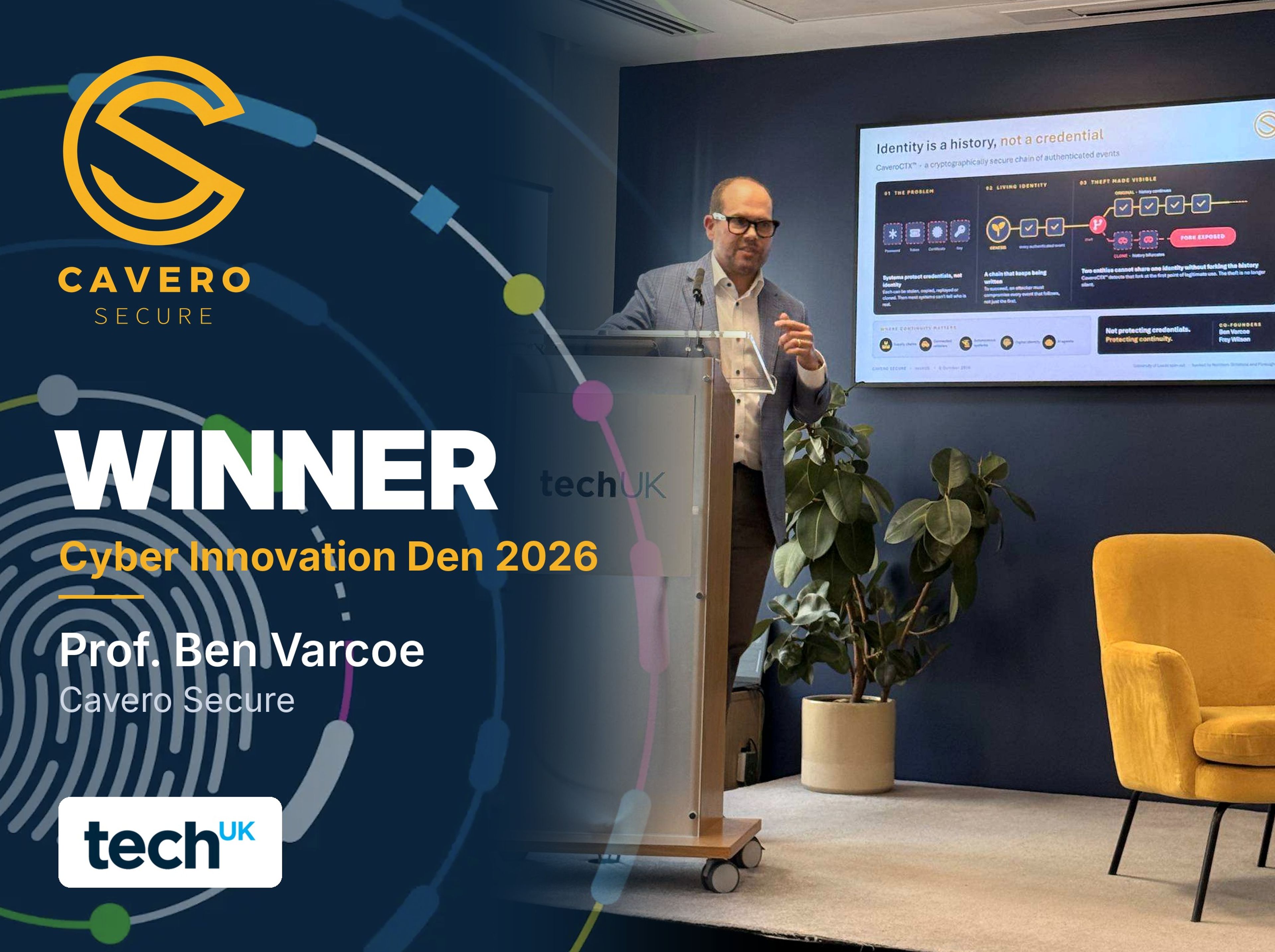
Cavero Secure has won the SME pitching competition at techUK's Cyber Innovation Den, taking the title of techUK's Cyber Innovator 2026. Professor Ben Varcoe, our Co-Founder, pitched CaveroCTX™ and the idea at its heart: the Living Cryptographic Identity.
We were one of ten UK cyber security SMEs selected to pitch solutions that use emerging technology to secure UK supply chains. Each finalist had three minutes to make their case to a panel of judges from Accenture, NHS England, iD Mobile and OneAdvanced. Watch Ben's winning pitch.
The win is a strong validation of our approach, and of why this technology matters now.
Credentials are not identity
Cyber security has long conflated identity with credentials. Passwords, tokens, certificates, keys, badges and licences help a system recognise an entity, but they don't define it. Your passport isn't you.
The problem isn't new, but it is becoming urgent. The systems that support the UK's critical national infrastructure are no longer single, isolated assets. They are supply chains of devices, software components, sensors, suppliers, updates, vehicles and, increasingly, AI agents, all interconnected and each identified by a credential.
Put those two facts together and the risk is clear. If a credential can be stolen, copied, replayed or cloned, whoever holds it can impersonate a genuine entity. Most systems have no native way to tell whether the entity presenting it is still the one that originally entered the supply chain. That is the gap the Living Cryptographic Identity closes.
What is a Living Cryptographic Identity?
A Living Cryptographic Identity isn't something an entity possesses. It is derived from the history the entity builds.
When a device, vehicle, AI agent or supply chain component is onboarded to your network, CaveroCTX™ records every authenticated interaction as part of a cryptographically secure, continuously evolving history. The entity is trusted because it can prove continuity with its own authenticated past, not because it presents the right credential.
Conventional security tries to make credentials harder to steal. CaveroCTX™ assumes a credential will eventually be stolen, and ensures an attacker can't use it to impersonate a genuine endpoint silently and indefinitely. Every entity's history is unique. Even if an attacker copied an endpoint's entire history, two endpoints presenting the same history is itself detectable, so the theft can no longer go unnoticed.
Strengthening what operators already have
CaveroCTX™ doesn't replace existing certificates, keys, identity platforms or supply chain assurance processes. It sits above them, adding a persistent, post-quantum secure identity-continuity layer across the whole life of an entity, whether that's a sensor, a connected vehicle, a supplier service or an AI agent. Nobody has to rip anything out.
That is why CaveroCTX™ has applications at many levels of the technology stack and across many industries. As Ben said of the pitching experience: "It didn't feel like pitching against nine other competitors; it felt more like being in a room with nine potential collaborators. There's so much that so many people can do with CaveroCTX™ to strengthen security against both current and future threats."
The next generation of trust and identity
The judges were looking for technology that could help secure UK supply chains. We believe that starts with being able to trust every data source: knowing that every device, sensor or agent you have deployed has an unbroken chain of trust going back to the day it was deployed. CaveroCTX™ is built to provide that proof.
We'd like to work with anyone who is ready to usher in the next generation of trust and identity services. Watch Ben's pitch. Click these links to see CaveroCTX™ in action, or get in touch to talk about what it could do for your systems.